
As The Field of 68 revives round-the-clock hoops in South Carolina, programs face radical wake-up schedules, shifted meals and tactical adjustments in pursuit of national opening-day visibility.
When Northern Illinois and Grambling tipped off at 3 a.m. Eastern on Monday inside the Rock Hill Sports & Event Center, the arena clock displayed an hour normally reserved for empty gyms and deep sleep. Three hours later, Appalachian State and Merrimack walked onto the same court for a 6 a.m. sunrise start. For four mid-major programs opening their 2026-27 men's college basketball seasons in South Carolina, the initial test of the year arrived without standard morning shootarounds or traditional pregame routines.
The graveyard schedule forms the backbone of The Field of 68 Opening Day Marathon, an eight-game showcase split between Rock Hill and the Sanford Pentagon in Sioux Falls, South Dakota. High Point and Liberty launched the event at 12:01 a.m. Eastern, establishing a relentless pace for a 24-hour broadcast featuring 16 programs from 14 conferences. While round-the-clock college basketball was an annual November fixture on ESPN from 2008 through 2017, its modern return demands practical biological and nutritional adjustments from coaching staffs unwilling to let strange hours sabotage opening-day performance.

For first-year Northern Illinois head coach Matt Majkrzak, preparing for a 2 a.m. Central start required balancing biological realities with psychological simplicity. Taking over a Huskies roster featuring zero returning scholarship players, Majkrzak declined to invert his team's entire practice schedule in DeKalb during the week leading up to the trip. Instead, the staff relied on short-term schedule shifts after touching down in South Carolina, focusing on mental readiness over complex sleep science.
Majkrzak noted before the opener that overthinking an abnormal tip time often creates more anxiety for players than the clock itself. If an athlete cannot find adrenaline for the first game of a season, the coach observed, the scheduled hour hardly matters. His players embraced a pragmatic approach. Huskies guard Max Weisbrod explained that the team initiated wake-up alarms at 4 a.m. the previous morning to ease internal clocks forward, treating the post-midnight tip as an extended evening fueled by late-night energy drinks.
Sports science departments across college athletics generally warn that disrupting circadian rhythms impairs reaction time, lateral mobility and shooting accuracy. Yet mid-major coaching staffs operating without dedicated sleep-tracking technology opted for streamlined solutions. Teams staggered travel itineraries, pushed light shooting sessions toward midnight, and instructed training staffs to schedule light carbohydrate meals precisely four hours prior to pregame warmups.
While Northern Illinois navigated late-night wakefulness, Merrimack head coach Joe Gallo faced the opposite dilemma for Monday's 6 a.m. matchup against Appalachian State. Preparing student-athletes to compete at full physical intensity at daybreak required setting hotel alarms before 3:30 a.m. and serving pregame breakfast before the surrounding city woke up. Gallo, whose program captured the Metro Atlantic Athletic Conference regular-season crown last winter, adapted his morning routine to ensure his roster completed dynamic stretching before dawn.
The early morning start also magnified tactical pacing. Both Merrimack and Dustin Kerns' Appalachian State squad ranked near the slowest tempo in Division I men's basketball a year ago. Facing Gallo's signature 2-3 zone defense requires crisp perimeter passing and disciplined half-court reads. With shooting eyes and depth perception often sluggish during dawn games, coaches emphasized ball security, paint touches and defensive rebounding over high-variance perimeter attempts.
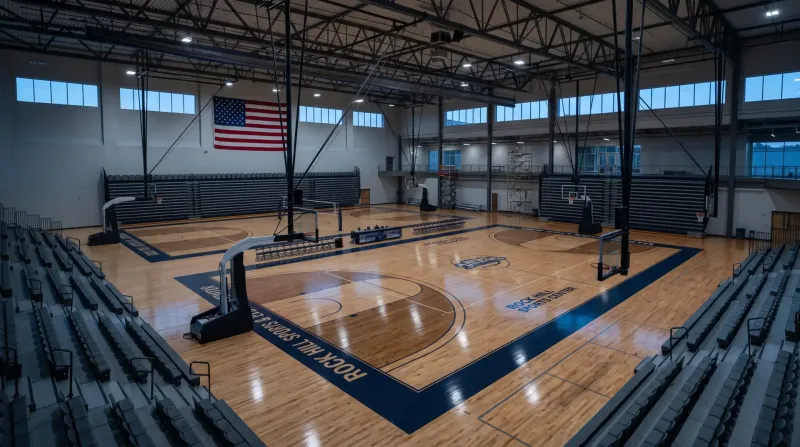
Coaches accept these physiological hurdles because the calendar offers mid-major programs very little room for standalone attention. On a typical opening Monday, dozens of multi-team events and high-profile power-conference matchups saturate national broadcast networks. A game played between midnight and sunrise on The Field of 68's YouTube and X feeds commands an attentive, highly engaged basketball audience that would otherwise disappear beneath evening football telecasts and premier neutral-site showdowns.
Field of 68 co-founders Jeff Goodman and Rob Dauster assembled the 16-team field specifically to spotlight programs operating outside college basketball's traditional power conferences. For coaches like Majkrzak, Gallo and Kerns, managing disrupted sleep patterns and bizarre breakfast hours represents a modest price for national exposure. Following the sunrise conclusion in Rock Hill, the marathon shifts to Sioux Falls for midday matchups before returning south for prime-time battles, leaving coaches with film, a completed opener and an immediate opportunity to catch up on rest.
Source:
Mid-Major Madness October 29, 2026
The Field of 68 Daily / Beehiiv August 11, 2026
Shaw Local / Daily Chronicle October 29, 2026
College Basketball Schedule October 29, 2026



Comments
No comments yet — be the first.
Leave a comment