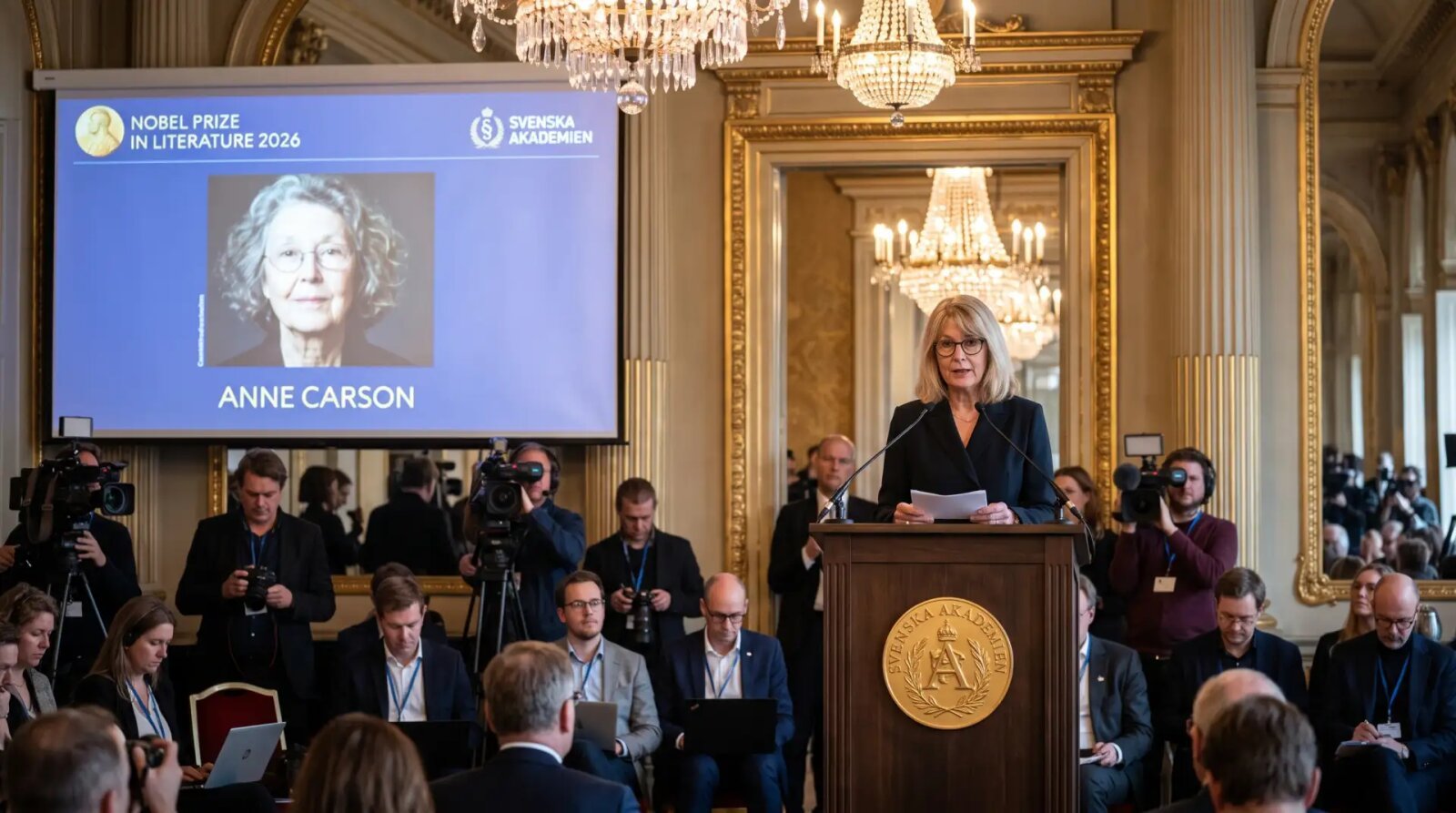
The 76-year-old author of Autobiography of Red was reached in Iceland listening to the wind after the Stockholm committee recognized her career bridging ancient Greek myth with modern lyric form.
STOCKHOLM — The Swedish Academy named Canadian poet, essayist and translator Anne Carson the winner of the 2026 Nobel Prize in literature on Thursday, honoring a career that transformed classical antiquity into adventurous modern literature.
Anders Olsson, chairman of the Nobel committee, announced the award in Stockholm, praising Carson for moving beyond standard lyric conventions to establish new structures for contemporary writing. The academy formally recognized her for her bold and inventive oeuvre that, in playful dialogue with the classical tradition, has created new forms for contemporary literature.
Carson, 76, received the news while traveling in Iceland. Permanent Secretary Ingrid Carlberg reached the author by telephone shortly before the public announcement at academy headquarters. Carlberg reported that Carson was listening to the wind when the call arrived, noting that the writer was surprised and happy, with genuine joy audible in her voice.
Born in Toronto in 1950, Carson built her literary foundation through classical scholarship, earning three degrees from the University of Toronto, including a 1981 doctorate examining desire in ancient verse. She spent more than three decades teaching ancient Greek language and literature at universities across North America, including McGill University and the University of Michigan, while writing poetry that questioned established literary categories.
Her debut book arrived in 1986 with Eros the Bittersweet, an influential critical study exploring how ancient writers understood desire through the painful distance separating lovers. That volume established her enduring method of blending rigorous textual analysis with personal contemplation and philosophical inquiry.
Broad international attention followed the 1998 publication of Autobiography of Red, which remains her most famous creation. Drawing on surviving verse fragments by the ancient Greek poet Stesichorus, Carson reimagined Geryon, a red winged monster killed by Herakles in mythology, as an insecure modern teenager enduring isolation, family strain and painful heartbreak. By placing ancient mythic figures into ordinary contemporary settings, she showed that ancient stories preserve intense psychological truth for modern readers.
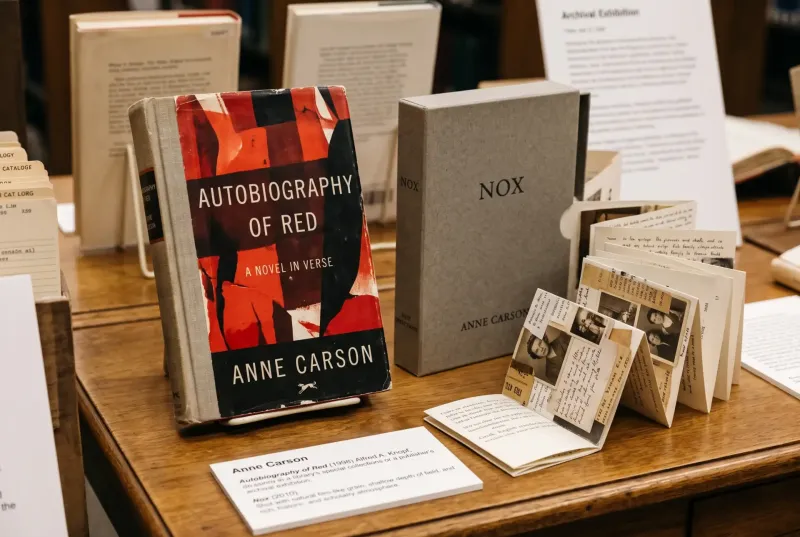
Carson has continually rejected standard definitions of genre, treating composition as a tangible visual craft. She once observed that she thought of making a poem as making an object, viewing her texts as drawings that readers can enter through language.
That sculptural approach shaped inventive publishing presentations. Her 2000 collection Men in the Off Hours placed ancient figures alongside modern cultural figures including Virginia Woolf and painter Edward Hopper. In 2001, The Beauty of the Husband: A Fictional Essay in 29 Tangos made Carson the first woman to receive the prestigious TS Eliot Prize for poetry.
A decade later, Carson produced Nox, an unformatted memorial composed after the death of her brother. Rather than a standard book, the work was published as an accordion fold facsimile of a private scrapbook housed in a grey box, assembling pasted photographs, dictionary entries translating Catullus, family letters and handwritten reflections. Later publications sustained that formal daring, including the dramatic adaptation Antigonick, the stage piece Norma Jeane Baker of Troy, and the 2024 volume Wrong Norma, which brought together stories, prose poems and critical sketches.
Fellow writers have celebrated Carson for decades as a unique stylist. The late American critic Susan Sontag observed that Carson was among the few living writers in English whose work she would read automatically. In Canada, fellow author Margaret Atwood congratulated her warmly, while Prime Minister Mark Carney commended her singular vision, stating that her wit and imagination had introduced ancient tales to global readers while transforming contemporary ideas about literature.
The literature prize has been awarded 119 times since 1901, recognizing 122 authors. Carson joins previous Canadian laureate Alice Munro, who won in 2013, and recent international recipients including Louise Gluck, Annie Ernaux and 2025 winner Laszlo Krasznahorkai. Bookmakers had ranked Carson among the leading candidates alongside Chinese writer Can Xue before the announcement.
The Nobel award provides a cash prize of 12 million Swedish kronor, currently valued at approximately 1.2 million dollars. Carson will formally receive the Nobel medal and diploma from King Carl XVI Gustaf during the annual presentation ceremony at the Stockholm Concert Hall on December 10, the anniversary of the death of Alfred Nobel.
Sources
The Guardian, October 8, 2026
NobelPrize.org, October 8, 2026


Comments
No comments yet — be the first.
Leave a comment