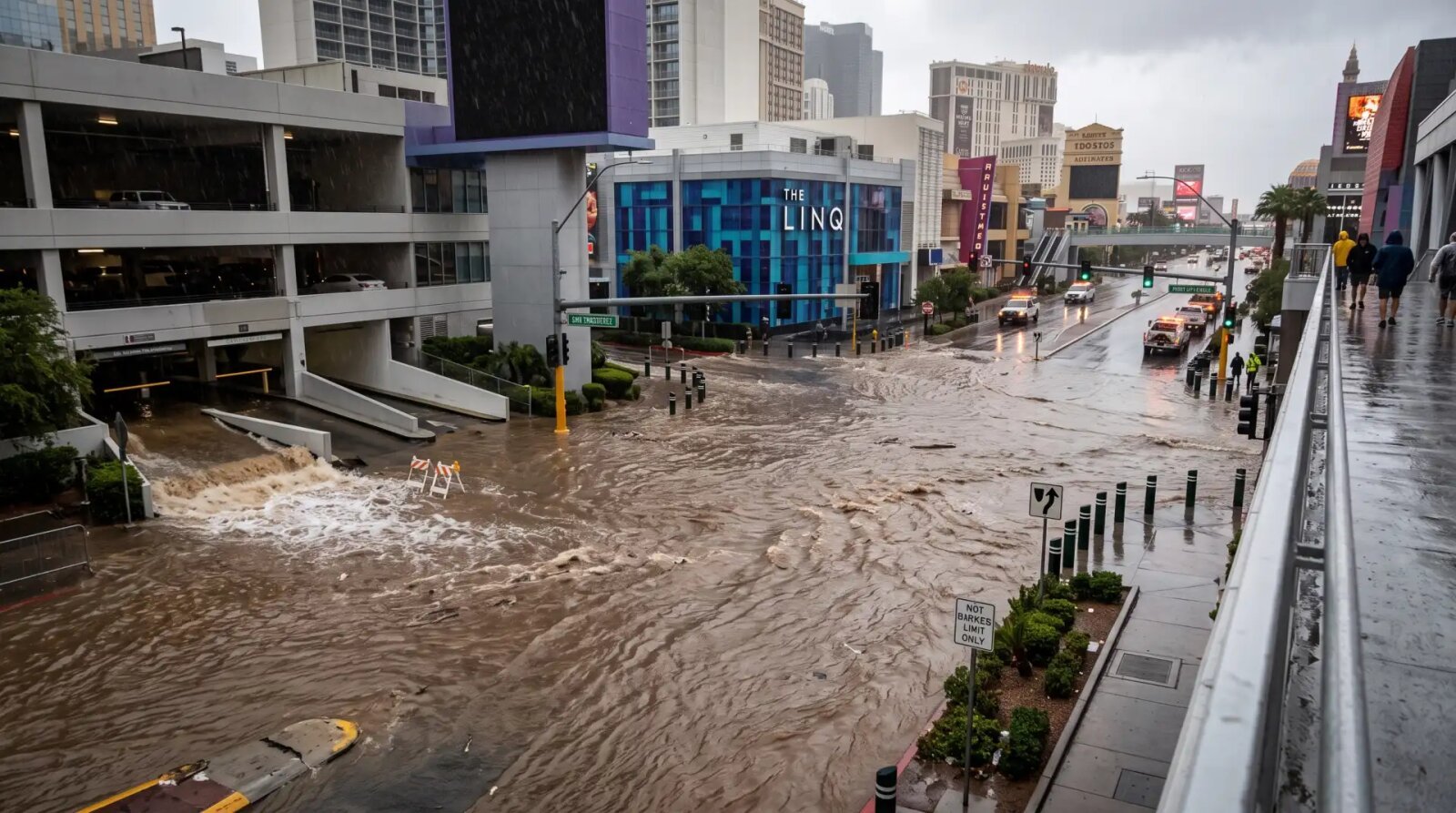
Record desert rainfall submerged casino parking garages and stranded valley motorists on Sunday, yet the runoff failed to meaningfully lift the critical Colorado River reservoir from historic drought lows.
LAS VEGAS - Raging runoff swamped resort corridors and broke rainfall records across southern Nevada on Sunday, demonstrating the volatile nature of Tropical Storm Rachel Las Vegas flooding as the post-tropical system dumped relentless rain over the desert Southwest. Even as torrents submerged hotel garages along the Strip, water authorities confirmed that the historic deluge provided virtually no relief to nearby Lake Mead.
The Pacific storm previously battered coastal Southern California, producing high surf and coastal inundation around Long Beach, before moisture plumes pushed inland across the Mojave Desert. Upon arriving over the Las Vegas Valley on Sunday morning, the system unleashed intense cloudbursts. Ground sensors documented between one and three inches of rain across metropolitan neighborhoods, an astonishing accumulation for an arid ecosystem that typically averages only four inches over an entire calendar year. Gauges in northwest Centennial Hills registered more than 2.5 inches, while Harry Reid International Airport shattered its daily precipitation record as intense rainfall rates briefly exceeded one inch per hour across western Clark County.
Surging water quickly overwhelmed urban drainage infrastructure along the resort corridor. Flash flooding cascaded through the subterranean parking facility beneath The LINQ Promenade just off the Strip, an entertainment venue constructed directly over a natural flood wash. Roaring torrents flowed toward the Sphere and surrounding properties near the Rio hotel, leaving ride-share drivers unable to reach hotel entrances as casino maintenance crews deployed squeegees and shop vacuums. Clark County officials instituted emergency closures along Koval Lane and Winnick Avenue as stranded automobiles stalled in moving water. Further south, floodwaters breached the pavement along Primm Boulevard and Interstate 15 near the California border, halting traffic along the primary interstate artery.
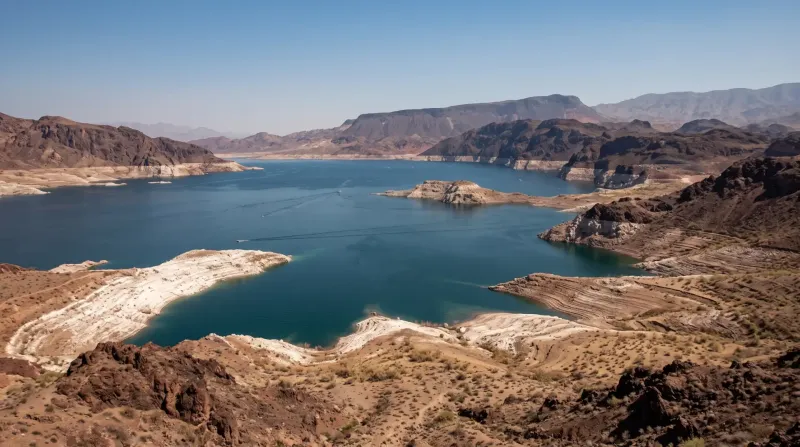
Despite dramatic footage of submerged casinos and inundated highways circulating globally, federal hydrologists noted that the localized precipitation did almost nothing to replenish regional water storage. Official measurements logged after the storm showed Lake Mead hovering near 1,037.75 feet above mean sea level, leaving the reservoir stagnant at roughly 26 percent of its total capacity. That level marks a steep decline from April 2024, when the reservoir stood at 1,072.65 feet.
The disconnect highlights a fundamental principle of southwestern hydrology. The Las Vegas Valley storm-water network funnels urban drainage down the Las Vegas Wash into Lake Mead to prevent residential flooding, yet localized runoff represents a minuscule fraction relative to the reservoir vast storage footprint. Lake Mead relies on the upper Colorado River Basin hundreds of miles to the northeast for roughly ninety percent of its annual inflow. Snowpack accumulated across the high peaks of the Colorado Rockies, Utah, and Wyoming drives spring melt into the river system. A brief, violent storm over the Mojave Desert cannot substitute for sustained mountain precipitation, and urban storm flows often carry sediment that adds little usable volume. The Bureau of Reclamation continues to project strict conservation requirements throughout the lower basin.
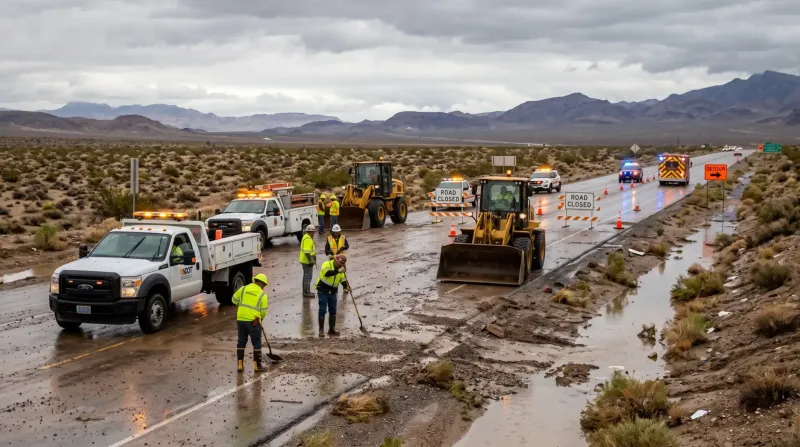
The destructive runoff also underscores the distinct vulnerability of desert topography to tropical remnants. Arid soils contain dense caliche layers that prevent moisture infiltration, transforming dry desert washes into powerful channels within minutes of heavy downpours. Urban pavement and concrete parking structures across the resort district amplify this runoff, accelerating water velocity into low-lying casino districts.
Emergency agencies, including Las Vegas Fire and Rescue, deployed swift-water rescue personnel to assist trapped motorists across the valley, issuing urgent reminders for drivers to avoid crossing flooded intersections. The National Weather Service maintained flash flood watches through Monday morning as scattered thunderstorm cells lingered over southern Nevada and heavy road debris lingered along major thoroughfares. Water managers noted that while channels carried millions of gallons through the wash, the total volume amounted to a negligible fraction of an inch on the reservoir elevation gauge. Regional water supplies remain constrained under federal shortage guidelines.
Source:
The Weather Channel (weather.com)
Comments
No comments yet — be the first.
Leave a comment