
Nearly a decade of telescope observations in Chile reveals that violent magnetic outbursts, rather than gentle starlight alone, can hurl carbon, oxygen, and nitrogen into space.
Astronomers using Chile's Atacama Large Millimeter/submillimeter Array have captured a massive, magnetized loop of gas erupting from the red giant star Mira A, overturning a decades-old model of how dying stars disperse the chemical ingredients for new planets.
Published November 23, 2026, in two papers in Astronomy & Astrophysics, the researchers draw on nearly ten years of observations taken between 2017 and 2025. An international team led by Wouter Vlemmings and Miora Andriantsaralaza at Chalmers University of Technology in Sweden found that violent magnetic storms—not gentle starlight pushing on dust—can drive the stellar winds that seed the Milky Way with carbon, oxygen, and nitrogen.
Mira A sits about 330 light-years from Earth in the constellation Cetus. Cooler than the Sun yet far older, larger, and brighter, the star offers astronomers a real-time preview of how our own solar system's star will behave billions of years from now.
When aging stars like the Sun exhaust their core fuel, they swell into red giants and shed their outer atmospheres into interstellar space. For decades, astrophysicists assumed this mass loss happened through a steady process in which starlight pushes outward on microscopic dust grains, gradually carrying gas away from the star.
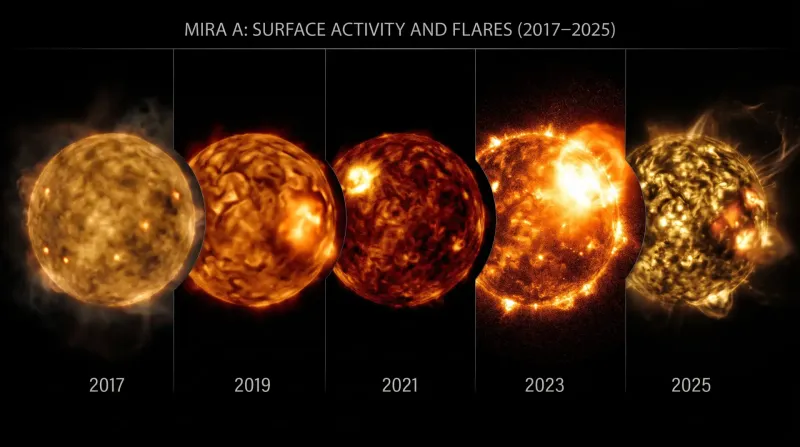
The new ALMA campaign, the longest continuous surface study of any star besides the Sun, revealed a turbulent reality on Mira A. Every time researchers imaged the star over the eight-year span, its brightest surface patches had shifted. Those hot spots turned out to be intense stellar flares releasing enormous bursts of energy.
"We were astonished to see how the star's surface is constantly changing," said Andriantsaralaza, a postdoctoral researcher at Chalmers University of Technology. "The brightest areas were different every time we looked, and the brightest patches are amazingly bright. We realised that star is flaring, releasing vast amounts of energy each time."
The team estimates that the most powerful flare recorded during the campaign, observed in 2023, outshone any flare previously detected on a comparable star.
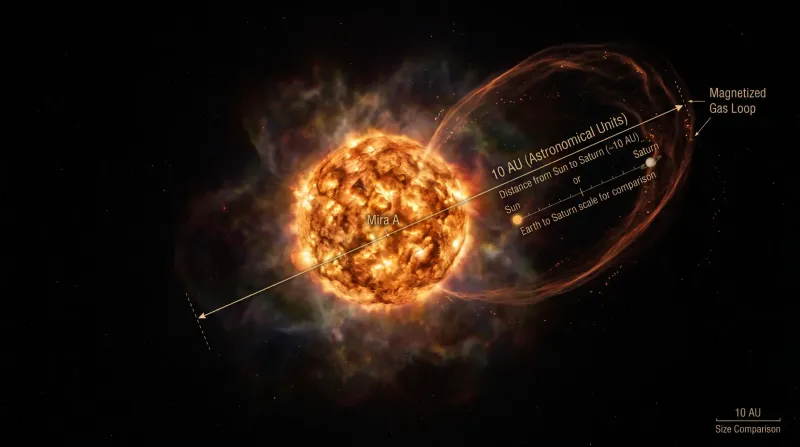
In 2025, follow-up ALMA observations revealed what the 2023 eruption left behind: an expanding arch of gas stretching 10 astronomical units from Mira A's surface, roughly the distance between the Sun and Saturn. Featured November 23 as the European Southern Observatory's Picture of the Week, the image showed a structure astronomers had never directly resolved around a red giant.
"In 2023, we saw one of these flares appear on the star's surface, but it didn't stop there," said Behzad Bojnordi Arbab, a doctoral student at Chalmers and co-author of the studies. "Over the next two years, this eruption on the surface created a vast, expanding loop of gas around the star, which we captured in an image in 2025. The loop was much bigger than the star, extending as far out as the distance of Saturn from the Sun. We hadn't seen anything like that before."
By measuring polarized light from the gas with ALMA, the team confirmed that strong magnetic fields thread through the loop. That magnetic signature links the surface flares directly to the outward ejection of matter, mirroring the coronal mass ejections seen on the Sun—events that send charged particles streaming toward Earth and trigger auroras.
Until now, astronomers did not expect red giants to generate solar-style magnetic eruptions capable of expelling substantial mass.
The findings carry broad implications for how galaxies recycle matter. Elements essential to rocky planets and life—including carbon, oxygen, and nitrogen—are forged inside stars and must escape into space before new solar systems can form.
"Now we see that magnetic storms on Mira's surface are continually creating bright flares," Andriantsaralaza said. "Even more surprisingly, each of these is strong enough to lift parts of the star's outer layers and launch them into interstellar space."
Vlemmings, a professor of astronomy and plasma physics at Chalmers, noted that future models of evolved stars must incorporate magnetism alongside radiation pressure on dust.
"Our study has consequences for our understanding of the whole of the galaxy's ecosystem," Vlemmings said. "Perhaps, Earth wouldn't be here if it wasn't for magnetic storms on a red giant star, billions of years ago before the Sun was born."
Source:
Star's record eruption shows how key elements can spread through space — November 23, 2026
Mira lives up to its name — November 23, 2026
Star's record eruption shows how key elements can spread through space — November 23, 2026
Mira lives up to its name (potw2647a) — November 23, 2026
A giant magnetic eruption from the asymptotic giant branch star Mira A (2608.23695) — August 24, 2026
Comments
No comments yet — be the first.
Leave a comment