
Following the short-lived 2026 run of its first triple-folding phone, Samsung is said to be testing a redesigned dual-hinge system to shed bulk and improve durability.
Samsung is reportedly developing a second-generation triple-folding smartphone that aims to trim roughly four millimeters from its predecessor's folded thickness ahead of a potential 2027 launch.
Supply-chain leaks and tipster reports indicate the unannounced device, widely referred to as the Galaxy Z TriFold 2, targets a folded profile of about 8.9 millimeters. That figure would bring the three-panel handset close to the thickness of Samsung's single-fold Galaxy Z Fold 7, down from the 12.9-millimeter chassis of the original Galaxy Z TriFold.
The first-generation model rolled out in South Korea on December 12, 2025, followed by Singapore, the United Arab Emirates, and Taiwan later that month, before reaching the United States on January 30, 2026, at $2,899. Samsung ended sales in South Korea and Singapore in March 2026 and sold out its remaining U.S. inventory in April 2026, directing shoppers on its website to the Galaxy Z Fold 7 or Galaxy S26 Ultra.
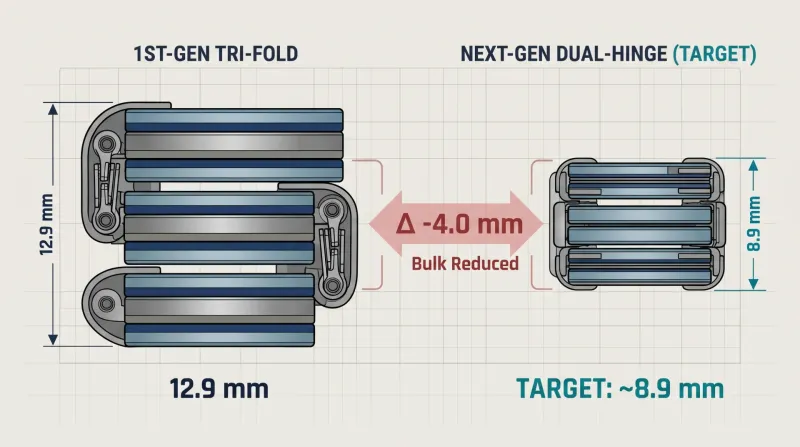
Reducing a tri-fold phone to 8.9 millimeters requires reworking the hardware that connects its three display panels. According to Korean tipster yeux1122 and supply-chain coverage from SamMobile and Android Authority, Samsung has completed most verification testing on a new dual-hinge mechanism designed to cut both thickness and weight.
The original Galaxy Z TriFold weighed 309 grams, compared with 215 grams for the Galaxy Z Fold 7. Reviewers and early buyers frequently cited that pocket bulk as the primary tradeoff for carrying a 10-inch inner screen, even though the device measured between 3.9 and 4.2 millimeters thick when unfolded. Packing flagship hardware—including a Snapdragon 8 Elite processor, 16GB of RAM, a 200-megapixel main camera, and a 5,600 mAh battery—into an even thinner three-panel frame adds considerable mechanical complexity.
Beyond shedding millimeters, the updated hinge architecture is expected to improve panel alignment, folding smoothness, and long-term durability. Reports compiled by Geeky Gadgets note that the next model is tipped to retain an IP48 rating for water and dust resistance alongside a roughly 10-inch folding OLED interior screen and a 6.5-inch cover display. Android Authority also reported that a slightly modified version of the new hinge could eventually reach standard Galaxy Z Fold and Galaxy Z Flip models.
Separate Samsung patent filings describing digitizer-free stylus tracking have sparked speculation about possible S Pen support without adding extra display layers. Samsung has not confirmed whether any stylus technology or multi-cell battery changes will appear in a commercial tri-fold successor.

The Galaxy Z TriFold 2 reports sit within wider speculation about Samsung's 2027 mobile hardware roadmap. Industry chatter points to an expanded Galaxy Z lineup that could include standard flip and book-style foldables alongside higher-tier Fold variants and a refined tri-fold flagship.
SamMobile and other outlets have also reported early development work on a separate hybrid handset featuring a slidable OLED panel, informally dubbed the Galaxy Z Slide. Unlike motorized prototypes Samsung Display previously demonstrated at CES and MWC, that experimental model is said to rely on a manual sliding mechanism that expands horizontally into a larger screen.
Any commercial rollout for a slidable device remains uncertain, with reports placing a potential announcement in late 2027 or early 2028 if Samsung chooses to move forward.
Hitting an 8.9-millimeter target would not automatically guarantee commercial traction. Multi-panel OLED displays, precision dual hinges, and multi-cell batteries carry high component costs, and a July 2026 report from Smartprix suggested manufacturing cost issues could complicate the release schedule.
Pricing expectations remain unsettled across recent leaks. Some reports anticipate Samsung holding near the original $2,899 launch price ceiling, while other estimates suggest a $2,199 to $2,599 range if manufacturing yields and production volumes scale up meaningfully.
At ultra-premium prices, demand typically narrows to enterprise buyers and early adopters. Wireless carriers and retail partners also tend to limit inventory commitments on expensive niche hardware because of return and repair risks, while prospective buyers continue to watch screen crease wear, repair costs, and multi-window app scaling.
Samsung has not publicly confirmed the Galaxy Z TriFold 2, its final specifications, its pricing, or its 2027 launch timing, leaving all reported dimensions and schedules subject to change before any official product announcement.
Galaxy Z Trifold 2 Leaks Point to ~8.9mm Thickness as Samsung Eyes 2027 (November 23, 2026) —
After discontinuing Galaxy Z TriFold, Samsung is working on a thinner successor (March 18, 2026) —
Missed your shot at a Galaxy Z TriFold? A successor could be in the works with a new hinge (April 18, 2026) —
Samsung's Galaxy Z TriFold Is Delayed By Cost Issues, And A Rollable Phone May Arrive Before It (July 14, 2026) —


Comments
No comments yet — be the first.
Leave a comment