
The former Bucknell athlete collapsed two miles before the finish line while running in memory of her grandfather, highlighting the extreme dangers of exercise-induced muscle breakdown.
Rachel Apa, a 24-year-old former collegiate athlete competing in her first New York City Marathon, died Sunday evening after collapsing near the 24-mile mark in Central Park.
Doctors determined that Apa suffered from rhabdomyolysis, a dangerous medical syndrome triggered by the rapid destruction of damaged skeletal muscle tissue, her father told The New York Times.
Apa, who previously played Division I field hockey at Bucknell University, entered the 26.2-mile race as part of the Parkinson's Champions team. She worked as a product manager for an electrical components firm while pursuing an MBA at Charleston Southern University, running the marathon to honor her late grandfather, who died from Parkinson's disease in 2022. On her fundraising page, she noted that her grandfather served as a primary role model who inspired her to stay active, test personal boundaries, and embrace difficult physical challenges.
Her family traveled to New York to support her across the five boroughs. Her mother recorded video footage of Apa smiling and waving near mile 14. By the 18th mile, however, the runner encountered severe physical distress, sending brief text messages of "Ow" and "Ow, ow" to her father. Steve Apa tracked his daughter's progress through the official mobile application, sending encouraging messages at each mile marker. At mile 23, he sent a text reading "Final stretch," but received no reply.
Course tracking records indicated Apa had maintained an average pace of seven minutes and 57 seconds per mile, crossing the 23-mile checkpoint in three hours and two minutes before halting abruptly near mile 24 around 1:30 p.m.
Spectators, including a hospital social worker named Michaela Nicholas and several bystander physicians, rushed to administer chest compressions after discovering Apa had no detectable pulse. Race medical personnel quickly arrived on scene with an automated external defibrillator before municipal paramedics transported her to Mount Sinai Medical Center.
Emergency physicians worked for more than six hours to revive Apa, but she was pronounced dead at 9:40 p.m. Her father expressed profound grief over the sudden loss. "It's unfathomable," Steve Apa told The New York Times. "Perfect health, perfect shape, 24 years old." He noted that his daughter had trained diligently for months.
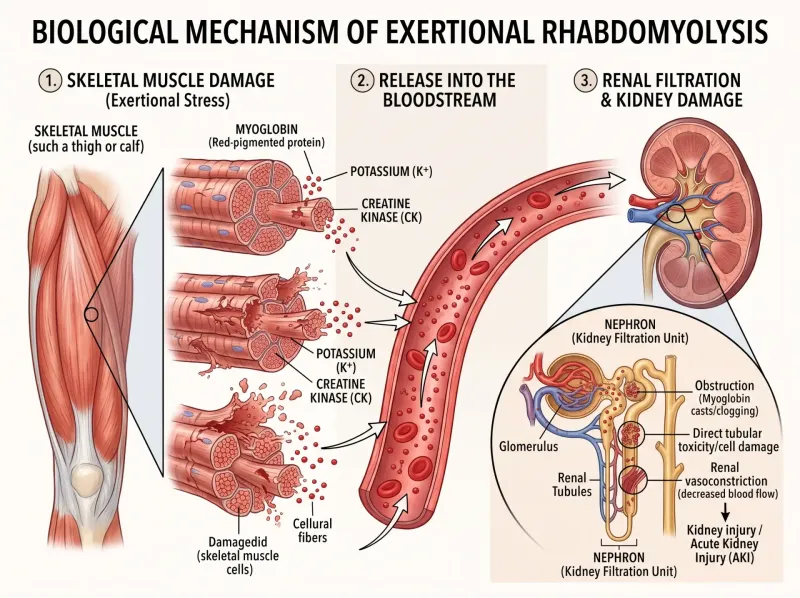
Rhabdomyolysis develops when skeletal muscle fibers sustain catastrophic structural disintegration, rupturing their cellular membranes and releasing internal components directly into the systemic circulation.
The cellular discharge contains large quantities of enzymes, electrolytes such as potassium, and myoglobin, an iron-rich, oxygen-binding muscle protein.
When heavy concentrations of myoglobin enter the bloodstream, the molecules overwhelm the filtration capacities of the kidneys. The resulting accumulation obstructs microscopic renal tubules, precipitating acute kidney injury, toxic metabolic disturbance, and life-threatening cardiac arrhythmias triggered by surging potassium levels.
Registries across the United States document approximately 26,000 cases of rhabdomyolysis each year, but exertion-induced fatalities among young, conditioned athletes remain exceedingly uncommon.
Clinical risk factors escalate sharply when prolonged physical exertion coincides with dehydration, high ambient temperatures, viral illness, or unaccustomed physiological strain. Standard emergency treatment requires aggressive intravenous fluid therapy to preserve renal blood flow and flush myoglobin through the urinary tract. In critical cases, patients require hemodialysis to filter metabolic waste while intensive care teams stabilize cardiac rhythm.

New York Road Runners, the organization that organizes the annual race, confirmed that Apa was the first participant fatality at the event since 2024. A record field of 61,146 runners started Sunday's race across the city.
The condition has previously surfaced within competitive collegiate athletics. In September 2024, five players on the men's lacrosse roster at Tufts University required hospitalization for rhabdomyolysis following a voluntary, supervised 45-minute conditioning workout led by a recent Navy SEAL graduate. That incident prompted an independent investigation into extreme exertion protocols.
Sports medicine specialists emphasize that exertional rhabdomyolysis frequently masquerades as routine marathon fatigue during its earliest stages. Runners often push through severe physical distress under the assumption that intense pain is simply part of long-distance competition.
Hallmark warning signs include muscle pain disproportionate to effort, localized swelling, profound weakness, and dark, tea-colored urine resulting from myoglobin filtration.
Physicians urge endurance athletes to prioritize gradual conditioning, manage electrolyte intake, and seek immediate medical evaluation whenever severe cramping or sudden physical depletion occurs.
Source:
The New York Times (via verified secondary sports and wire coverage) November 2–3, 2026
Gulf News / Bild / Sport Bild November 3, 2026



Comments
No comments yet — be the first.
Leave a comment