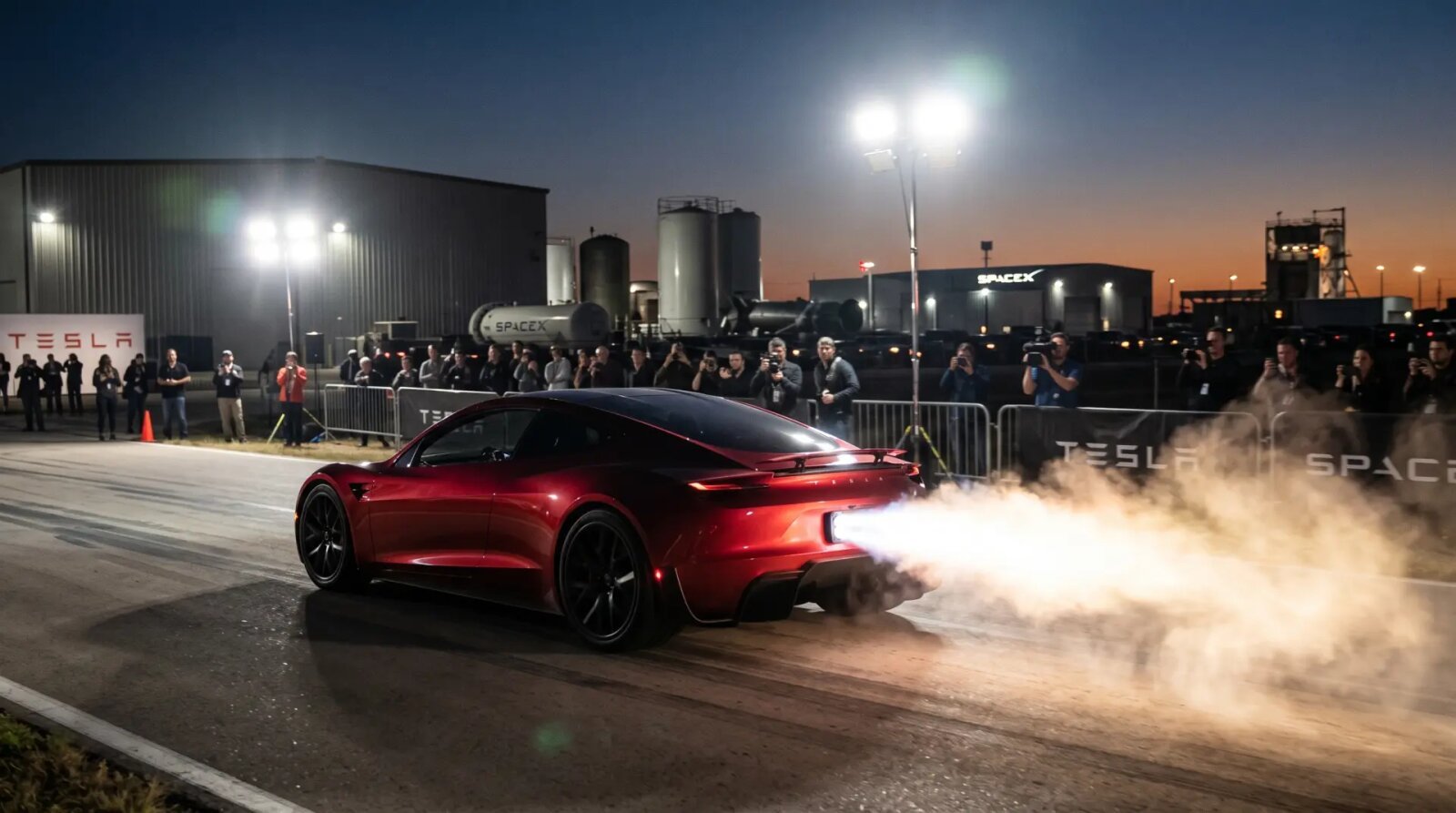
Demonstrated at a Texas rocket facility after nine years of delays, the electric sports car uses cold-gas jets and underbody suction while fueling Wall Street expectations of a corporate merger.
MCGREGOR, Texas – Nearly nine years after first promising a second-generation halo sports car, Elon Musk unveiled a redesigned Tesla Roadster equipped with rocket thrusters Thursday evening at a SpaceX testing facility in central Texas. The electric automaker announced that commercial production is scheduled to begin in 2028, following a stunt-filled demonstration that showcased deepening engineering integration between Musk automotive and aerospace ventures.
During the presentation at SpaceX rocket development complex in McGregor, engineers demonstrated the two-seater coupe driving upside down along a specialized ramp using an underbody suction fan system.
A separate demonstration showed the vehicle launching into the air, rotating mid-flight, and landing with the assistance of built-in SpaceX cold-gas thrusters. Regulatory pathways and legal approval for operating such aerodynamic and propulsion systems on public highways were not immediately clear.
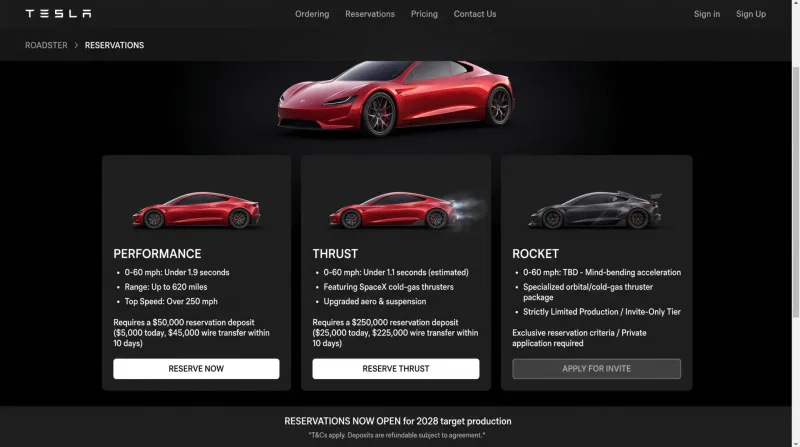
Musk told attendees that the redesigned model can sprint from zero to 60 mph in less than one second, with demonstration telemetry clocking 0.81 seconds, and exceed a top speed of 230 mph. While executives declined to disclose final retail pricing, Tesla updated its online reservation portal after the presentation to list three distinct configurations. Buyers seeking the entry Performance model must place a $50,000 deposit, structured as an initial $5,000 payment followed by $45,000 within ten days, whereas a Thrust trim featuring acceleration thrusters requires a $250,000 deposit. A third, invite-only single-seat variant labeled the Rocket edition is described as carrying a full flight system.
When Tesla first previewed a prototype in November 2017, Musk promised deliveries by 2020, quoting a $200,000 base price for a four-seat layout capable of traveling 620 miles on a single charge.
Despite the theatrical debut, Musk has previously downplayed the sports car impact on company earnings, calling the program a small potato situation in 2023 that would not move the needle in a major way financially. Morningstar analyst Seth Goldstein projected that Tesla will sell roughly 2,000 Roadsters annually, representing a sliver of the 1.6 million vehicles the manufacturer delivered last year.
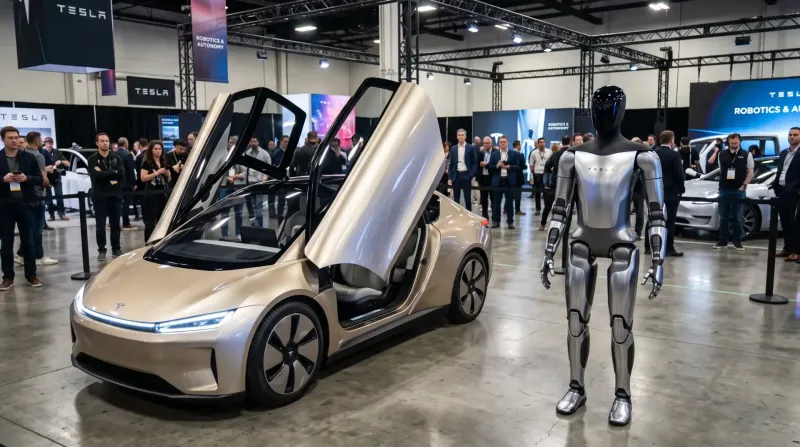
Even so, analysts view the model as an important technological flagship after Tesla discontinued its aging Model S sedan and Model X sport utility vehicle earlier this year to clear factory floor space for building Optimus humanoid robots. The company has increasingly pivoted away from conventional passenger vehicles toward artificial intelligence and autonomous mobility, recently introducing its two-seater Cybercab robotaxi constructed without a steering wheel, pedals, or side mirrors.
Tesla does not currently have a halo car, or high-performance luxury vehicle designed to showcase an automaker best engineering and technology, Goldstein wrote in a research note, adding that the new model fills that symbolic void and echoes the original Lotus Elise-based Roadster sold between 2008 and 2012 before the company scaled with its Model 3 and Model Y.
Staging the automotive reveal inside a SpaceX rocket facility also intensified Wall Street expectations that Musk could soon combine his two most valuable enterprises. In a report published ahead of the event, Barclays analyst Dan Levy stated that a formal merger between Tesla and SpaceX could be announced before Tesla annual shareholder meeting, which must convene by December 6.
Barclays modeled an all-stock acquisition in which SpaceX, valued near $2.1 trillion following its June initial public offering and February purchase of xAI, absorbs Tesla, valued around $1.5 trillion. Such a transaction would give Musk roughly 56 percent voting control across the combined empire. Levy noted the tie-up would be pitched as an artificial intelligence vertical integration play, linking Tesla autonomous vehicles, energy storage products, and Optimus robots with SpaceX Grok software, Starlink satellite connectivity, and the planned $19.8 billion Terafab computing complex. Following the McGregor showcase, Tesla shares climbed nearly 5 percent in Friday trading as investors weighed the technical demonstration and merger possibilities.
Source:
Comments
No comments yet — be the first.
Leave a comment